
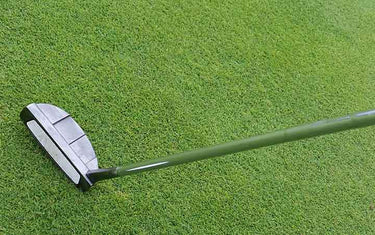
Standard putter length refers to the default length a putter is manufactured at when no custom fitting or modification is applied. For most golfers, this is the length they encounter when browsing putters in-store or online, and it has traditionally served as the industry’s baseline measurement. While the term “standard” suggests something fixed or universally correct, in reality it represents an average intended to suit the widest possible group of players rather than a perfectly optimised fit for any individual golfer.
For decades, standard putter length was almost universally accepted as 35 inches. This measurement became embedded in golf retail and manufacturing because it worked reasonably well for golfers of average height using a traditional putting stance. As putting instruction and equipment knowledge evolved, however, the limitations of a one-size-fits-all approach became increasingly clear. Today, standard putter length is better understood as a starting point rather than a final answer.
When golfers begin exploring putters, whether upgrading their current flat stick or shopping for their first serious option, understanding what standard length means provides valuable context. It explains why a putter may feel comfortable at address, why another feels awkward despite being labelled “standard,” and why small differences in length can have a noticeable impact on confidence and consistency on the greens.
Why 35 Inches Became the Traditional Standard
The 35-inch standard emerged during a time when putter design was relatively simple and fitting was far less common. Most putters were compact blade designs, golfers stood more upright, and instruction focused less on detailed biomechanics. Manufacturers needed a single length that would not feel extreme for most players, and 35 inches sat comfortably in the middle of the bell curve.
This measurement quickly became the default across major brands, reinforcing its status as the norm. Golfers grew accustomed to seeing 35 inches on spec sheets, and many assumed it was the “correct” length rather than a compromise. As mallet putters gained popularity and head weights increased, the same standard length carried over, even as putting styles began to diverge.
Many golfers still perform well with a 35-inch putter, particularly those who prefer a more upright posture or have longer arms relative to their height. However, as modern instruction has highlighted the importance of posture, eye position and stroke repeatability, it has become clear that the traditional standard does not suit everyone equally.
How Modern Putting Has Redefined Standard Length
In recent years, the definition of standard putter length has subtly shifted. Many modern putters, especially those inspired by tour usage, now come stock at 34 inches. This change reflects a growing emphasis on posture and alignment rather than simply accommodating average height.
Tour professionals have played a major role in this evolution. As putting analysis has become more detailed, players and coaches have identified that slightly shorter putters often promote better setup positions, with the eyes closer to directly over the ball and the shoulders more naturally engaged in the stroke. Manufacturers have responded by adjusting their default offerings to better align with these findings.
As a result, golfers shopping today may find that “standard” varies by brand and model. Some still adhere to 35 inches, others default to 34, and certain putters are offered in both lengths as stock options. This variability underscores the importance of understanding what standard length represents rather than assuming it will automatically suit your game.
The Relationship Between Putter Length and Eye Position
One of the most significant ways putter length influences performance is through eye position at address. Where your eyes sit relative to the ball and target line plays a crucial role in how accurately you aim and how confidently you start the ball on line.
A putter that is too long often encourages the eyes to sit inside the target line. While some golfers can adapt to this, many struggle with inconsistent alignment and directional misses. A slightly shorter standard-length putter can help bring the eyes closer to the ball, improving visual perception and making it easier to trust your aim.
This is one reason many golfers notice an immediate difference when testing putters that are only an inch shorter than what they are used to. Even within the range of what is considered standard, small adjustments can create meaningful improvements in how the stroke feels and performs.
How Length Influences Posture and Stroke Mechanics
Beyond alignment, putter length has a direct impact on posture and the way the body moves during the stroke. A longer putter tends to promote a more upright stance, which can reduce natural shoulder rotation and encourage excessive hand or wrist involvement. This often leads to inconsistent tempo and distance control.
Conversely, a putter that is too short can force a golfer to bend excessively from the waist, creating tension in the arms and shoulders. This tension makes it difficult to produce a smooth, repeatable motion and can negatively affect both start line and pace.
Standard putter length is designed to avoid these extremes for most players, but it cannot perfectly accommodate individual differences in height, flexibility and stance width. Two golfers of the same height may still require different lengths based on how they naturally set up to the ball. This is why standard length should always be evaluated in the context of comfort and repeatability rather than accepted at face value.
Why Standard Length Differs Between Blade and Mallet Putters
Putter head design also plays a role in how standard length feels. Blade putters, which tend to suit players with more arc in their stroke, often feel more precise and controllable when slightly shorter. The compact head and feedback-oriented design reward a setup that promotes face awareness and touch.
Mallet putters, on the other hand, are built for stability and forgiveness. Their larger heads and higher moment of inertia can pair well with a more upright posture, which is why many mallets are still offered at traditional standard lengths. Golfers who prefer a straighter back-and-through stroke often find mallets at standard length easier to control, particularly on longer putts.
Understanding this relationship helps golfers make better choices when browsing different putter categories. Length should complement the design and purpose of the putter, not work against it.
Weight, Balance and the Pitfalls of Cutting Down a Putter
Putter length cannot be separated from weight and balance. When a putter is manufactured at standard length, the head weight and grip are chosen to achieve a specific swing weight and feel. Shortening a putter without adjusting these elements can significantly alter its performance.
A cut-down putter often feels too light in the head, leading to poor distance control and an unstable stroke. This is a common issue for golfers who buy a standard-length putter and later attempt to modify it without professional guidance. Choosing a putter that already suits your preferred length helps preserve the intended balance and ensures the putter performs as designed.
For golfers considering changes, this highlights the value of selecting from a wide range of lengths rather than assuming modification is the best solution.
Why Used Putters Are Ideal for Finding the Right Length
Used putters offer a unique advantage when it comes to exploring standard length. Because they span different generations of design, they reflect both traditional and modern interpretations of what standard means. Golfers can find classic 35-inch models alongside newer 34-inch options, often within the same brand family.
This variety allows players to experiment with feel, posture and alignment without the higher cost associated with buying new. It also makes it easier to discover whether a subtle change in length improves confidence and consistency on the greens.
For golfers still refining their preferences, used putters provide a practical way to learn what truly works before committing to a long-term setup.
Using Standard Putter Length as a Baseline, Not a Rule
Ultimately, standard putter length exists to provide a reference point. It simplifies manufacturing and retail, but it does not define what is best for every golfer. The most effective putter length is the one that allows you to set up comfortably, align naturally and repeat your stroke with confidence.
By understanding what standard length means and how it has evolved, golfers are better equipped to make informed decisions. Whether you gravitate toward a classic blade or a modern mallet, using standard putter length as a baseline rather than a rule can lead to better performance and greater trust on the greens.
To explore a wide range of putters in various lengths and designs, browse our range of used putters for sale in NZ and find the one that suits your stroke perfectly.
If your after more information around buying a putter, we've put together a handy putter buying guide.