
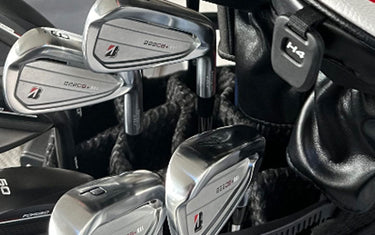
If you're looking at buying a new set of golf irons, you've probably come across the usual names: TaylorMade, Callaway, Ping, Titleist and Mizuno. But what about Bridgestone?
Known by many golfers primarily for its golf balls, Bridgestone has also produced a wide range of golf irons over the years. Its Tourstage range, in particular, has developed a following among golfers who appreciate traditional clubhead designs, forged construction and the performance of Japanese golf equipment.
But are Bridgestone irons actually good? Are they suitable for high handicappers, or are they mainly designed for experienced golfers? And if you're looking at an older set of Bridgestone irons, are they still worth buying today?
Yes, Bridgestone has made some very good golf irons. However, the right choice depends on the individual model, your playing ability, and what you're looking for in a set of clubs.
Some Bridgestone irons are compact players' irons designed around feel and control, while others offer a more forgiving design suited to a wider range of golfers. This guide explores what makes Bridgestone irons worth considering and what to look for when buying a set.
A brief history of Bridgestone golf irons
Bridgestone is a Japanese company with a long history in golf equipment. While its golf balls are particularly well known, the brand has also developed a substantial range of golf clubs, including drivers, fairway woods, wedges and irons.
Many golfers will be familiar with the name Tourstage, which was used across a large range of Bridgestone golf equipment. Tourstage irons have included everything from traditional muscle-back irons to cavity-back and game-improvement designs.
Over the years, Bridgestone and Tourstage have produced several notable iron families, including:
- Tourstage X-Blade irons
- Tourstage ViQ irons
- Tourstage TS-202 irons
- Tourstage J33, J36 and J40 irons
- Bridgestone J15 irons
- Bridgestone Tour B irons
- Bridgestone JGR irons
One of the interesting things about this range is that these irons were not all designed for the same type of golfer.
For example, the X-Blade family includes more compact, traditional designs, while the ViQ and JGR families include irons aimed at golfers wanting additional forgiveness and easier launch.
This is important when shopping for used Bridgestone irons. A set of X-Blade irons may offer a very different experience from a set of Tourstage ViQ irons, even though both carry the same manufacturer's heritage.
What makes Bridgestone irons good?
There are several reasons why Bridgestone irons are worth considering, particularly if you're looking at premium used golf clubs.
1. Feel and forged construction
Bridgestone has produced a number of forged irons over the years, which is one of the reasons the brand appeals to golfers who enjoy a more traditional feel.
Forged irons are generally made by shaping metal into the desired clubhead design. Many golfers associate forged construction with a softer, more responsive feel at impact.
However, it's important to understand that not every Bridgestone iron is forged, and forged construction alone doesn't guarantee that an iron will perform better for your game.
Feel is influenced by several factors, including the clubhead design, materials, construction, shaft and the quality of the strike.
For golfers who enjoy the sensation of a well-struck iron, Bridgestone's forged models can be an appealing option.
2. Traditional clubhead designs
Many Bridgestone and Tourstage irons have a traditional appearance, particularly the more performance-focused models.
This can include:
- Compact clubheads
- Thinner toplines
- Less offset
- Narrower soles
- Traditional cavity-back or muscle-back designs
Some golfers prefer this appearance because it gives them confidence when addressing the ball. Others may find a larger game-improvement iron more comfortable to look down at.
Neither is necessarily better. The important thing is choosing a design that suits your preferences and ability.
The Tourstage X-Blade CB 2008 is an example of a Bridgestone/Tourstage iron with a more traditional players' cavity design. It may appeal to golfers who want a compact-looking iron without necessarily moving to a full muscle-back.
3. A wide range of performance options
One of Bridgestone's biggest strengths is the variety of irons it has produced.
Rather than being a brand exclusively associated with blades or low-handicap clubs, Bridgestone has offered irons for different playing abilities.
Some models are built around:
- Feel and shot control
- Forgiveness
- Distance
- Launch
- Traditional appearance
- A combination of these characteristics
This means you shouldn't dismiss Bridgestone irons simply because you consider yourself a beginner or higher-handicap golfer.
The individual model matters much more than the logo on the back of the club.
Are Bridgestone irons good for high handicappers?
Yes, some Bridgestone irons can be suitable for high handicappers, but you need to choose the right design.
A high-handicap golfer will generally benefit from irons that provide a good level of forgiveness and make it easier to get the ball airborne.
Features worth looking for include:
- Larger clubheads
- Wider soles
- More perimeter weighting
- Additional offset
- A lower centre of gravity
- Designs that help with launch and distance
Some of Bridgestone's ViQ and JGR irons are examples of models that move towards this more forgiving category.
The Tourstage ViQ range, in particular, included irons designed around ease of use and game-improvement characteristics. These are worth considering if you're looking for a more forgiving used iron rather than a compact players' club.
That said, you shouldn't assume every ViQ model is suitable for every high handicapper. Different generations and versions can have different specifications, lofts and designs.
If you're buying a used set, look closely at the actual clubhead rather than relying on the name alone.
What about beginners?
If you're a beginner, the most important thing is finding an iron that helps you develop consistency and confidence.
A compact players' iron may look attractive, but it can be less forgiving if you're still learning to strike the ball consistently.
A larger cavity-back iron may be a more practical starting point.
Bridgestone has produced irons in this category, so it's worth investigating the more forgiving models rather than assuming the brand is only for experienced golfers.
Are Bridgestone irons good for mid handicappers?
Mid-handicap golfers have plenty of options when it comes to Bridgestone irons.
This is because many of the brand's models sit somewhere between traditional players' irons and larger game-improvement clubs.
A mid-handicap golfer may want a balance of:
- Forgiveness on off-centre strikes
- A traditional appearance
- Good feel
- Distance
- Control
- A comfortable sole design
The Tourstage TS-202 is an interesting example.
The TS-202 has a relatively traditional appearance but is often discussed by golfers as a model that offers a good balance of playability and forgiveness. It demonstrates why it's important not to assume that every older Japanese iron is a demanding club designed only for low handicappers.
For golfers who enjoy the look of traditional irons but still want some help around the course, models in this category can be worth exploring.
When shopping second hand, a set of TS-202 irons may be worth considering alongside more modern game-improvement irons, particularly if you prefer a more classic-looking clubhead.
Are Bridgestone irons good for low handicappers?
Bridgestone has also produced plenty of irons aimed at experienced golfers and those who prefer a more compact clubhead.
The Tourstage X-Blade range is a good example.
Models such as the X-Blade CB and X-Blade 701G are more performance-focused irons, with traditional shapes and designs that appeal to golfers who prioritise feel, control and workability.
These types of irons may suit golfers who:
- Strike the ball consistently
- Prefer a compact clubhead
- Want to shape their shots
- Value traditional looks
- Don't necessarily need maximum forgiveness
However, it's worth making a distinction between the X-Blade models.
A compact players' cavity such as the X-Blade CB can offer a different level of forgiveness from a traditional muscle-back. The X-Blade 701G also has a more forgiving design than the standard X-Blade 701.
So even within the X-Blade family, the specific model matters.
A low handicapper may enjoy a compact Bridgestone iron, but a mid handicapper who likes the appearance of a players' iron may also find some of these models appealing.
The key is to be realistic about your ball striking and the amount of forgiveness you need.
What about older Bridgestone irons?
This is one of the most interesting aspects of buying Bridgestone irons second hand.
Many of the models you come across today are no longer current. However, that doesn't automatically mean they are poor performers.
Golf iron technology has developed over time, but a well-designed iron from several years ago can still be a very capable club.
There are a few reasons why older Bridgestone irons can be worth considering.
Value for money
The biggest advantage is often price.
Older premium irons can be considerably cheaper than buying a new set, allowing golfers to access quality construction and performance without paying full retail.
For golfers who are trying to improve their equipment on a budget, this can make a big difference.
Traditional designs remain appealing
A compact cavity-back or forged iron doesn't suddenly become unsuitable because a newer model has been released.
If you prefer the appearance and feel of traditional irons, older Bridgestone models can still offer exactly what you're looking for.
Specifications matter more than age alone
When buying used irons, it's important to look at the actual specifications.
A modern 7-iron may have a stronger loft than an older 7-iron, so comparing distance based purely on the number stamped on the club can be misleading.
You should also consider shaft flex, shaft weight, loft, lie and the overall condition of the clubs.
A well-maintained older set with suitable specifications may be a better fit than a newer set that doesn't suit your swing.
What to check when buying used Bridgestone irons
If you're considering a second hand set of Bridgestone irons, there are several things worth checking before making a purchase.
1. Clubface and grooves
Look at the condition of the clubface and grooves.
Some wear is normal on used irons, but excessive groove wear can affect spin and consistency.
The amount of wear that's acceptable will depend on the age, condition and price of the set.
2. Shaft flex and weight
The shaft is one of the most important parts of the club.
A shaft that's too stiff, too flexible or too heavy for your swing may affect your ability to launch the ball and control your shots.
For example, a set of X-Stiff Bridgestone irons may appeal to a stronger, faster swinger, while a regular-flex set may be more appropriate for another golfer.
Don't choose a set based solely on the clubhead design.
3. Grip condition
Grips are a consumable part of any golf club.
If the grips are worn, they can generally be replaced, but it's worth considering the additional cost.
Good grips help provide a secure connection with the club and can make a difference to confidence and consistency.
4. Loft and lie
Older irons can have different loft and lie specifications from modern clubs.
If you're replacing an existing set, it's worth comparing the lofts to make sure the new clubs will provide useful distance gaps.
This is especially important if you're also carrying separate wedges.
5. Set makeup
Check which irons are included in the set.
Some used sets may be 5-PW, while others may include a 4-iron, gap wedge or additional clubs.
Consider whether the set gives you the coverage you need throughout your bag.
Bridgestone irons vs other major golf brands
Bridgestone is not the only manufacturer producing quality golf irons.
TaylorMade, Callaway, Ping, Titleist, Mizuno, Srixon and other brands all offer a wide range of designs for different golfers.
The important thing is not to choose based purely on brand reputation.
Instead, compare the individual model, clubhead design, specifications and condition.
For example, a golfer who wants maximum forgiveness may compare a Bridgestone game-improvement iron with a forgiving Ping or Callaway model.
A golfer who prefers a compact forged iron may compare a Bridgestone X-Blade with a Mizuno or Titleist players' iron.
There isn't one brand that's automatically right for every golfer.
If you're building a complete set of used clubs, you can also explore different brands across the bag. You might prefer Bridgestone irons but choose a TaylorMade or Callaway driver, for example.
You can browse our used golf drivers and used golf iron sets to compare different options.
Are Bridgestone irons worth buying second hand?
For the right golfer, yes.
Bridgestone has produced a broad range of golf irons, from compact players' models through to more forgiving game-improvement designs.
This makes the brand worth considering if you're shopping for used golf clubs and want something a little different from the most common names on the market.
The biggest advantage is that older Bridgestone irons can offer an appealing combination of performance, feel and value.
However, the right set will depend on your swing, playing ability and preferences.
A low handicapper may enjoy the feel and control of an X-Blade iron, while a mid or higher handicapper may prefer a more forgiving ViQ or JGR design.
The important thing is to look at the actual model rather than assuming all Bridgestone irons are the same.
Final verdict: Are Bridgestone irons good?
Yes, Bridgestone makes good golf irons, but the best model for you depends on what you need from your clubs.
The brand has produced a wide range of irons over the years, including traditional forged models, compact players' cavities and more forgiving game-improvement designs.
If you enjoy a traditional clubhead, value feel or want to explore Japanese golf equipment, Bridgestone is certainly worth considering.
If you're a higher handicapper, don't automatically rule the brand out either. There are Bridgestone models that offer more forgiveness and easier launch than the compact X-Blade-style irons.
When buying second hand, focus on:
- The individual model
- Clubhead design
- Forgiveness
- Shaft flex and weight
- Loft and lie
- Club condition
- Price
A well-maintained older set of Bridgestone irons can still be a great option for the right golfer.
At ARC Golf, we stock a range of used golf clubs from leading brands, including Bridgestone/Tourstage when available. If you're looking for your next set of irons, browse our used golf iron sets to see what is currently available.