
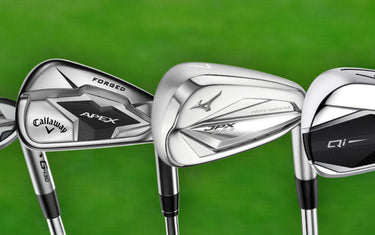
Game improvement irons are designed to make golf easier, more consistent, and more forgiving for the majority of players. While elite golfers often gravitate toward compact, traditional iron shapes, most amateurs benefit far more from clubs that actively help correct common mishits and ball-flight issues. That is where game improvement irons excel.
At their core, game improvement irons are engineered to reduce the penalty of imperfect strikes. They are built to help golfers launch the ball higher, maintain ball speed across the face, and achieve more predictable distances even when contact isn’t perfectly centred. For many players, switching to game improvement irons is not about lowering expectations, it is about using equipment that complements how they actually swing the club.
Understanding what defines a game improvement iron, and who they are best suited for, can help golfers make more informed decisions when upgrading or replacing their irons.
The Design Philosophy Behind Game Improvement Irons
Game improvement irons are built with one overriding goal in mind: forgiveness. This is achieved through a combination of clubhead shape, internal weighting, face technology, and sole design. Compared to traditional “player” irons, game improvement models typically feature a larger clubhead profile, a thicker topline, and a wider sole. While these visual differences may appear subtle to some golfers, they have a significant impact on performance.
One of the most important elements is perimeter weighting. By distributing mass around the edges of the clubhead rather than concentrating it behind the sweet spot, manufacturers increase the club’s moment of inertia. This means the club resists twisting when impact occurs away from the centre of the face, helping shots fly straighter and with more consistent distance. For golfers who miss the centre more often than they would like, this can be the difference between reaching the green and coming up well short.
Another defining feature is a low and deep centre of gravity. By positioning weight lower in the head, game improvement irons make it easier to get the ball airborne. This is particularly helpful for players with moderate swing speeds or those who struggle to achieve adequate launch with longer irons. The result is a higher peak height and a steeper descent angle, which can help shots stop more quickly on the green.
Modern face technology also plays a role. Many game improvement irons now use thin, flexible faces designed to preserve ball speed across a wider area. Even when impact drifts toward the toe or heel, the ball retains more speed than it would with a traditional forged blade. This consistency builds confidence and leads to more predictable yardages over time.
Who Are Game Improvement Irons Designed For?
Although often associated with beginners, game improvement irons are suitable for a far broader range of golfers than many people realise. They are commonly played by high-handicap and mid-handicap golfers, but they are also used by experienced players who prioritise consistency over shot-shaping.
Golfers who tend to strike the ball low on the face, lose distance on mishits, or struggle with directional control often benefit immediately from the added stability and launch assistance these irons provide. Players returning to the game after time away, or those whose swing speed has decreased over the years, may also find that game improvement irons allow them to maintain distance without forcing the swing.
It’s also worth noting that many modern game improvement irons are far more refined in appearance than their predecessors. Compact shaping, muted offset, and cleaner toplines mean that golfers no longer have to sacrifice confidence at address to gain forgiveness. This has made them an increasingly popular choice among golfers who might previously have dismissed them as “too chunky.”
If you’re unsure whether your current irons are helping or holding you back, exploring a modern game improvement iron category can be a valuable first step.
How Game Improvement Irons Affect Distance and Consistency
One of the most noticeable changes golfers experience when switching to game improvement irons is improved distance consistency. While raw distance gains do occur for some players, the more meaningful benefit is tighter yardage dispersion. Shots struck slightly thin or toward the toe tend to carry closer to the intended number, reducing the large gaps that can lead to missed greens.
Stronger lofts are often part of the equation, but they are not the sole reason for distance improvements. Launch conditions, ball speed retention, and spin optimisation all play a role. Game improvement irons are designed to produce playable trajectories that maximise carry while still providing enough stopping power on approach shots.
This consistency is especially valuable in the mid-to-long irons, where many golfers struggle the most. For players who find long irons intimidating, game improvement designs can restore confidence and make longer approach shots feel more achievable. This is one reason why many golfers choose blended sets, combining game improvement long irons with more traditional short irons.
If distance gaps or inconsistent carry numbers are an issue in your current set, upgrading to a forgiving iron design can have a measurable impact on scoring.
Game Improvement Irons vs Other Iron Categories
Understanding how game improvement irons differ from other iron types helps clarify where they fit within the broader equipment landscape. Compared to player’s irons, which prioritise feel and workability, game improvement irons focus on stability and ease of use. They are less punishing on mishits and require less precise ball-striking to achieve solid results.
They also differ from super game improvement irons, which take forgiveness to the extreme with oversized heads and very wide soles. While super game improvement irons are excellent for beginners, some golfers prefer the balance that standard game improvement irons offer between forgiveness and traditional shaping.
For many players, game improvement irons represent the most versatile and practical option. They provide performance benefits that translate directly to the scorecard without demanding elite swing mechanics.
Choosing the Right Game Improvement Irons
Selecting the right game improvement irons involves more than just choosing a brand or model. Shaft type, flex, and length all play a critical role in how the irons perform. A forgiving head paired with an ill-suited shaft can limit the benefits the design is meant to provide.
This is where professional fitting or guided selection becomes valuable. Even small adjustments can improve launch, dispersion, and feel. Golfers shopping for used or pre-owned game improvement irons can still benefit from understanding their specifications and choosing options that suit their swing profile.
If you’re considering upgrading, browsing our collection of game improvement irons can help narrow down models that align with your needs while offering excellent value.
Are Game Improvement Irons Right for You?
Game improvement irons are not a compromise, they are a performance tool designed to help golfers play better golf more often. For players who value consistency, forgiveness, and confidence at address, they can be transformative. Rather than focusing on what an iron looks like in a tour bag, these clubs prioritise what actually happens on the course.
Whether you are improving your game, returning after time away, or simply looking for irons that better match your swing, game improvement designs deserve serious consideration. Exploring available options and understanding how they differ from your current set can be a meaningful step toward lower scores and more enjoyable rounds.
If you’re ready to take the next step, you can browse our range of used irons for sale in NZ here.
We've also put together a comprehensive golf irons buying guide if you need more information around finding your next set of irons.
Frequently Asked Questions About Game Improvement Irons
What Are Game Improvement Irons?
Game-improvement irons are golf clubs designed with maximum forgiveness and distance technology to help everyday golfers hit straighter and higher shots.
What makes game improvement irons more forgiving?
Game improvement irons are more forgiving because they distribute weight around the perimeter of the clubhead and position the centre of gravity lower and deeper. This design helps maintain ball speed and stability on off-centre strikes, resulting in straighter shots and more consistent distances.
Are game improvement irons only for beginners?
No. While they are commonly recommended for beginners, game improvement irons are also widely used by mid-handicap golfers and even experienced players who prioritise consistency over shot shaping. Many modern designs offer a clean look at address while still providing significant forgiveness.
Do game improvement irons go farther than traditional irons?
They can, but the main benefit is consistency rather than raw distance. Game improvement irons are designed to optimise launch and preserve ball speed across the face, which helps reduce distance loss on mishits and leads to more predictable yardages.
Will game improvement irons help with slicing or hooking?
They can help reduce the severity of directional misses by minimising face twisting on impact. While they won’t fix swing flaws on their own, the added stability and higher launch can make mis-hits less punishing and improve overall shot dispersion.
Can low-handicap golfers play game improvement irons?
Yes. Many low-handicap golfers choose game improvement irons, particularly in the long irons, to gain extra launch and forgiveness. Blended sets that combine forgiving long irons with more traditional short irons are increasingly common.
How do game improvement irons compare to forged irons?
Game improvement irons are typically cast or multi-material and focus on forgiveness and launch, while forged irons prioritise feel and workability. Some modern game improvement models incorporate forged faces, narrowing the gap in feel while retaining forgiveness.
Are game improvement irons suitable for slower swing speeds?
Yes. Their low centre of gravity and flexible face designs make it easier to achieve proper launch and carry, which is especially beneficial for golfers with moderate to slower swing speeds.