
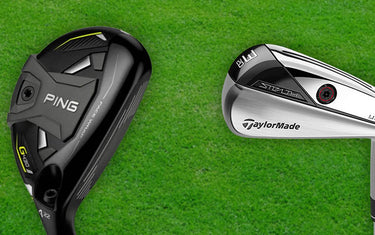
Understanding Why the Long-Game Gap Matters
For many golfers, the long-game gap is one of the most frustrating parts of the bag to dial in. Long irons can feel demanding, fairway woods aren’t always reliable off the deck, and distances in the 180–220m range often expose any mishit or inconsistency. That’s where hybrids and utility irons come into play. These two categories are designed to offer forgiveness, launch, and distance, but they do so in very different ways. Choosing the right option can reshape the way you approach long-range shots, par-5s, tight tee shots, and long approaches into greens.
Understanding the differences between these clubs isn’t just a matter of preference; it’s about matching the right tool to your swing behaviour, your strike tendencies, and the type of courses you typically face.
What a Hybrid Is Designed to Do
A hybrid is engineered to make long-distance shots easier. Its wider sole, deeper centre of gravity, and wood-like chassis promote higher launch, straighter ball flight, and forgiveness across the face. For many players, particularly beginners and mid-handicappers, hybrids often feel like a natural extension of the fairway wood, giving you height and carry even when you don’t quite catch the centre.
If your long-iron strike pattern tends to drift low on the face or towards the heel, a hybrid can transform what used to be a weak fade or a stinging low riser into something much more playable. If you’re exploring options, browsing our used hybrid golf clubs collection is an ideal place to start, as you’ll see how loft, shape, and forgiveness vary across models.
What Makes a Utility Iron Different
Utility irons appeal to players who want the iron-like feel, shaping potential, and turf interaction of a traditional long iron but with more forgiveness built in. Their hollow bodies, flexible faces, and internal weighting help produce a controllable, mid-to-high trajectory without compromising the more precise feel some golfers prefer.
While they require a more committed swing than a hybrid, they reward confident ball-strikers with a penetrating flight and improved workability. For golfers who enjoy the connection and feedback of their mid-irons, a utility iron provides a familiar feel with a much-needed boost in playability.
Trajectory and Shot Shape: The Real Difference
One of the clearest distinctions between hybrids and utility irons is the flight window. Hybrids naturally elevate the ball, maximise carry, and introduce a little more spin, helping shots hold greens or carry long hazards. This makes them especially useful on soft fairways, long approach shots, and situations where elevation is needed quickly.
Utility irons, by contrast, typically offer a flatter, more penetrating ball flight. This becomes invaluable in windy or links-like conditions, where height can turn into a liability. When you need a straight, stable tee shot on a narrow par 4 or a controlled approach from the fairway, the utility iron excels.
Swing Speed, Strike Pattern, and Player Profile
Swing speed plays an important role when deciding between the two. Hybrids perform brilliantly for moderate to slower swing speeds, as the deeper centre of gravity does part of the work to help you launch the ball higher. Utility irons, on the other hand, tend to reward golfers with moderate to faster swing speeds who can generate enough ball speed to take advantage of the club’s design.
Strike pattern matters just as much. A hybrid’s forgiveness helps maintain speed on off-centre strikes, especially low on the face. Utility irons, while still easier to hit than traditional long irons, provide a more stable line and reduce the tendency for the “left miss” that some golfers experience with hybrids.
Course Conditions and Playability
The course you typically play influences which club will perform better for you. Hybrids thrive on softer turf, rough, and winter conditions where you need help getting the ball airborne from tricky lies. Their rounded sole glides more easily through the grass, making them a strong rescue option.
Utility irons, meanwhile, shine on firmer fairways, tight lies, and windy courses. Their ability to produce a lower, more controlled flight gives you accuracy from the tee and predictability on the ground as the ball chases forward.
Many golfers carry both, using the hybrid for approaches and the utility iron for positional tee shots. But this depends entirely on your bag setup and the specific gaps you’re trying to solve.
Hybrid vs Utility Iron: How to Choose What’s Best for Your Game
Ultimately, the right choice comes down to what gives you confidence and consistency. Hybrids are unmatched for forgiveness, height, and ease of use, especially for beginners and mid-handicappers. Utility irons, however, are exceptional for precise ball-strikers who prefer the feel of an iron and the control it offers.
If you’re unsure which direction to go, testing both alongside your carry distances, launch angle, and strike pattern will quickly reveal which performs best. Your long-game setup is one of the most influential parts of lowering scores, especially on long par 4s and reachable par 5s.
Exploring our range of used hybrid golf clubs for sale and utility irons can help you find a club that suits your budget, swing, and preferred feel. As a leading online golf shop in NZ, we've also put together a extensive hybrids buying guide for more detailed information around what else to look out for when buying a new hybrid.
What This Means for Your Long Game
With the right hybrid or utility iron in your bag, you’ll not only close the gap between your long irons and fairway woods, you’ll also gain the confidence to attack shots that once felt out of reach. The decision isn’t about which one is universally better; it’s about which one elevates your game, keeps more shots in play, and gives you a predictable result when the pressure is on.